Microsoft has added new features to Microsoft 365 that include controls to automatically expire or revoke access to encrypted emails and data investigation capabilities.
from RSS Feeds | INTERNET - RSS Feed - NDTV Gadgets360.com http://bit.ly/2PGwzlX
Wednesday, 1 May 2019

A Midtown Speakeasy Popular With ‘Real Housewives’

By BRIAN SLOAN from NYT Style https://nyti.ms/2PEGnwL
Amazon, Ford Partner to Enable Package Deliveries to Owners' Cars
The 'Key by Amazon In-Car delivery' offering will be available for owners of select Ford 2017 and later model vehicles equipped with connectivity service.
from RSS Feeds | INTERNET - RSS Feed - NDTV Gadgets360.com http://bit.ly/2V9F3rO
from RSS Feeds | INTERNET - RSS Feed - NDTV Gadgets360.com http://bit.ly/2V9F3rO
5 Marketing Channels to Focus On In 2019
Even though Field of Dreams is one of my favorite movies, the saying “If you build it, they will come” sadly doesn’t apply to content marketing. Too often, we forget that content marketing consists of two keywords -- content and marketing. Creating content is usually the most fulfilling and enjoyable part of a marketer’s job. But distributing that content is just as crucial for your marketing success because if no one sees your content, they definitely won’t come.
To help you determine which marketing channels you should distribute your content through, we’ve put together a list of the marketing channels to focus on in 2019. Read on to learn about the marketing channels that can amplify your reach, resonance, and revenue.
1. Word of Mouth
Only 4% of consumers believe marketers practice integrity. So what’s a marketer to do when the very people they need to persuade don’t trust them? They need to rely on their customers’ recommendation of their brand.
People trust customers over marketers because marketers have an agenda -- they promote their product or service to generate sales. On the other hand, customers will only rave about a product or service if it truly benefited them.
To create as much word of mouth marketing as possible, you need to stay laser-focused on developing the best product or service possible and providing top-notch customer service. In other words, you need to serve your customers needs before your own. Only then will your customers turn into a loyal, passionate tribe that will recommend your brand to their friends and family.
2. Podcasts
According to a content format study conducted by Edison Research and Triton Digital, people age 12 and older are listening to online audio content at unprecedented levels. On average, people spend 17 hours per week tuning into their favorite podcasts, online radio shows, and audiobooks. There are also 14 million more weekly podcast listeners this year compared to last year, which is more than Guinea’s entire population.
The demand for audio content has exploded, but that doesn’t mean people will listen to your branded podcast just because it’s a podcast. In reality, they’ll only listen to it if it can hold their attention and, ultimately, entertain them. Otherwise, producing yet another interview-an-expert podcast like everyone else will only add to the noise flooding the internet.
One of the best ways to slice through all that corporate clutter is by creating a show that has a unique concept and tells stories of real professionals in your industry. According to researchers in the neuroscience field, storytelling is the best way to capture people’s attention, bake information into their memories, and resonate emotionally with them. The human brain is programmed to crave, seek out, and respond to well-crafted narrative -- that’ll never change.
3. Email
Wasn’t email supposed to die this year? And last year? And the year before that? As much as marketing gurus claim the final nail of email’s coffin is forthcoming, the data tells us it’s not even close. In the U.S., email usage has grown every single year since 2012 and 91% of American internet users use email.
As of now, subscribing to your favorite online publications through email is the best way to keep up with their latest stories and news. And since it takes an average of six to eight touch points to generate a qualified sales lead, persuading people to subscribe to your emails and, in turn, constantly consume your content will generate more leads and revenue for your business.
Growing an engaged, loyal subscriber base also speaks volumes about the quality of your content and its emotional resonance. Even though hoards of content saturate the internet and most people’s inboxes today, people are still actively engaging with your content, which is a clear sign that they actually value it.
4. Social Media
Most people surf social media to escape everyday life, entertain themselves, and connect with others. Sometimes, though, brands forget why people use social media in the first place, blindly pushing their content to as many people as possible.
With over 2.7 billion social media users across the globe today, millions of brands have promoted their content on these platforms for years. But the popularity of social media has flooded each platform with heaps of articles, photos, and videos, skyrocketing the supply of content while the demand for it has plateaued.
So how can brands cut through the noise? One strategy is to publish engaging videos, interact with fans as much as possible, and post content that doesn’t direct users to another website, like insightful status updates instead of links.
5. SEO
Search engines are arguably the best marketing channel for acquiring attention -- most people discover new brands and publications through Google. In fact, according to Google, 89% of B2B buyers and 81% of online shoppers use search engines to research new products and services.
Search engines are also one of the highest converting marketing channels. Since people actively search for answers to their questions and solutions to their problems on Google, they’re likely to download your offer or sign up for a free trial if you can provide them with what they’re looking for.
To build a thriving organic presence online, consider implementing the pillar-cluster model into your blog. Using this strategy, you’ll create a single pillar page that provides a high-level overview of a topic and hyperlinks to cluster pages that delve into the topic’s subtopics. This signals to Google that your pillar page is an authority on the topic.
Hyperlinking all of the cluster pages to the pillar page also spreads domain authority across the cluster, so your cluster pages get an organic boost if your pillar page ranks higher, and your cluster pages can even help your pillar page rank higher if they start ranking for the specific keyword they’re targeting.

from Marketing http://bit.ly/2J5PNjL
Reputation Management: How to Protect Your Brand Online in 2019
A positive brand image can undoubtedly influence a consumer's decision to buy a product -- and, for virtually every business, a positive brand image starts online.
Nowadays, your reputation is largely dependent on social media and online review sites. For instance, consumers need to read an average of 10 online reviews before they feel they can trust a local business.
Since brand image makes such an impression on someone's decision to purchase, it's critical you regularly monitor your reputation online.
Additionally, an unfavorable online reputation can have an extremely negative impact on your company's bottom line -- in fact, businesses risk losing up to 22% of their customers when users find just one negative article about the company.
However, monitoring and influencing your reputation can feel like a daunting task, particularly when so much of it -- including online reviews -- is out of your control. Fortunately, there are plenty of tools and strategies you can implement to ensure you're protecting your brand in 2019.
Here, let's explore reputation management software you can use to monitor your brand's reputation online, as well as strategies you can implement to manage your corporate reputation.

Reputation Management Software
To start managing your reputation online, it's helpful to use reputation management software. Particularly if you work for a small-to-medium sized business with limited PR resources, software can help you keep track of what people are saying online about your brand.
By using one of these software systems, you're able to mitigate negative reviews by responding to customers online, and even use their feedback as an opportunity to make your brand or product better.
1. Yext Reviews
Since inconsistent information can negatively affect your local SEO, it's critical you ensure your business's information is listed consistently across each site. Fortunately, Yext lets you fix any inconsistent business information in one place.
Additionally, the software enables you to manage your social media accounts and respond to authentic customer reviews, ensuring you have a good grasp on your brand's true online reputation. Yext is ideal for small-to-medium sized businesses as well as major enterprise companies -- some of its impressive customers include Marriott Hotels and T-Mobile.
Price: Starts at $199/year

Image courtesy of Yext.
2. ReviewTrackers
ReviewTrackers collects online reviews from over 100 third-party review sites, including Google, TripAdvisor, and Facebook -- best of all, you get a notification whenever a customer leaves a review, ensuring you're up-to-speed on customer feedback. The cloud-based reputation and review management software also allows you to track trending issues and topics to show you the bigger picture regarding customer issues, and provides competitor tracking and performance analytics.
The tool, used by customers such as Sears and Triple A, is available for enterprise companies as well as small-to-medium sized businesses.
Price: Custom depending on your size and business needs (request a demo here).
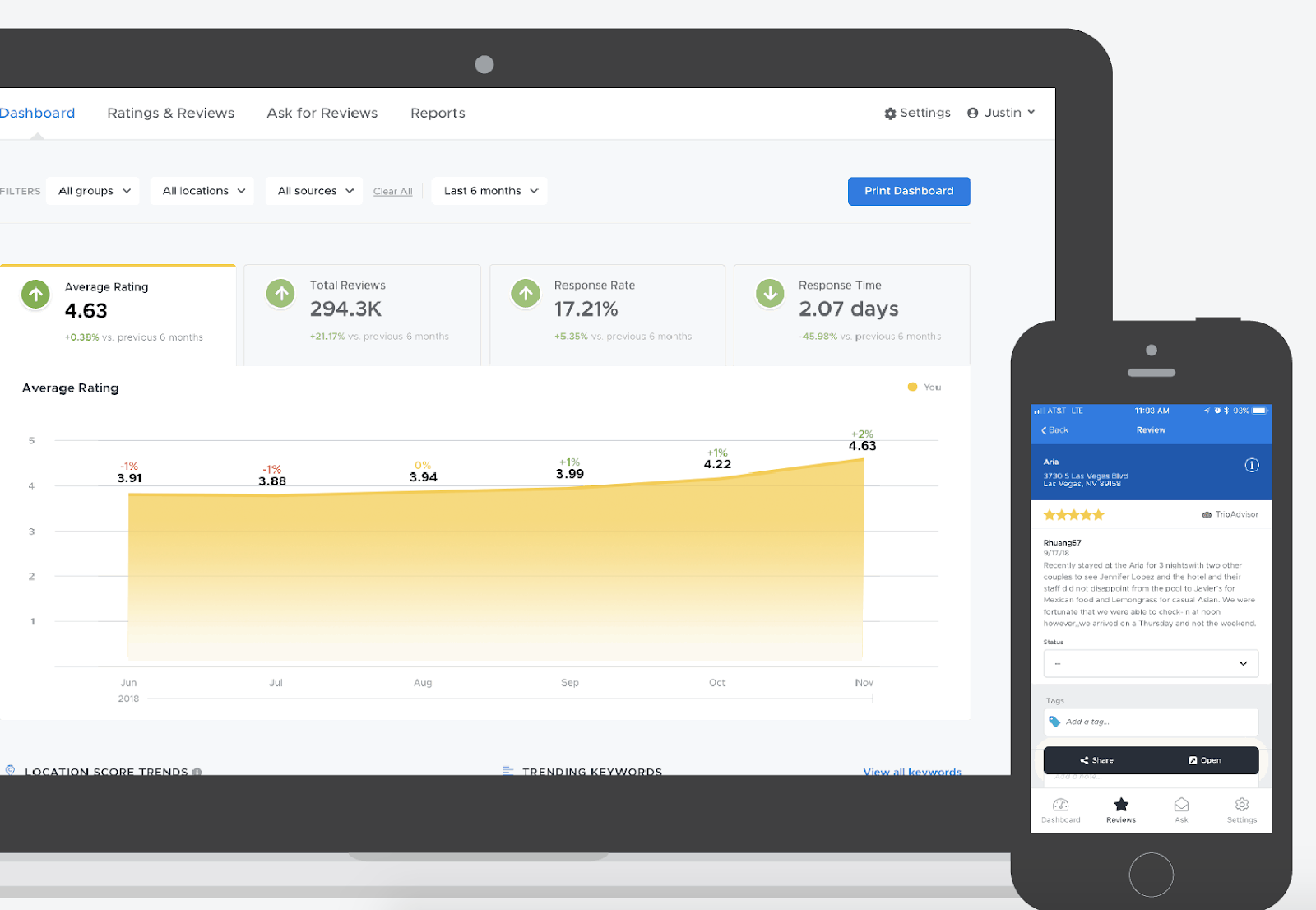
Image courtesy of ReviewTrackers.
3. Podium
More than likely, the idea of managing your reputation on different sites ranging from Facebook to Google to Yelp is a stressful and overwhelming one -- fortunately, software like Podium allows you to see all customer interactions and online reviews in a single dashboard. Your employees can use Podium to request reviews, respond to reviews in real-time, and even send text messages with potential customers.
Podium's support team is available via phone, online chat, or email, ensuring you have the help you need to properly implement their tool. The software works best for small-to-medium local businesses who have the time and resources to manually send texts to customers or leads.
Podium is a customer interaction platform that utilizes text messaging to help businesses manage customer relationships and build an online reputation on a variety of websites.
Price: Custom depending on your size and business needs. (Ask for quote here).

Image courtesy of Podium.
4. BirdEye
BirdEye, a SaaS reputation management tool used by more than 50,000 businesses, collects feedback from over 150 online review sources to ensure you have the full-picture regarding your brand's online reputation. You can monitor, promote, and respond to reviews within one dashboard -- additionally, you can use BirdEye to request reviews from customers on both desktop and mobile devices, or on BirdEye's own messenger tool.
Along with review monitoring, BirdEye provides features to manage your social accounts, gain insight into your competitors' customers, and create surveys and tickets to further improve your customer's overall experience with your brand.
Price: Custom depending on your size and business needs. (Ask for quote here).
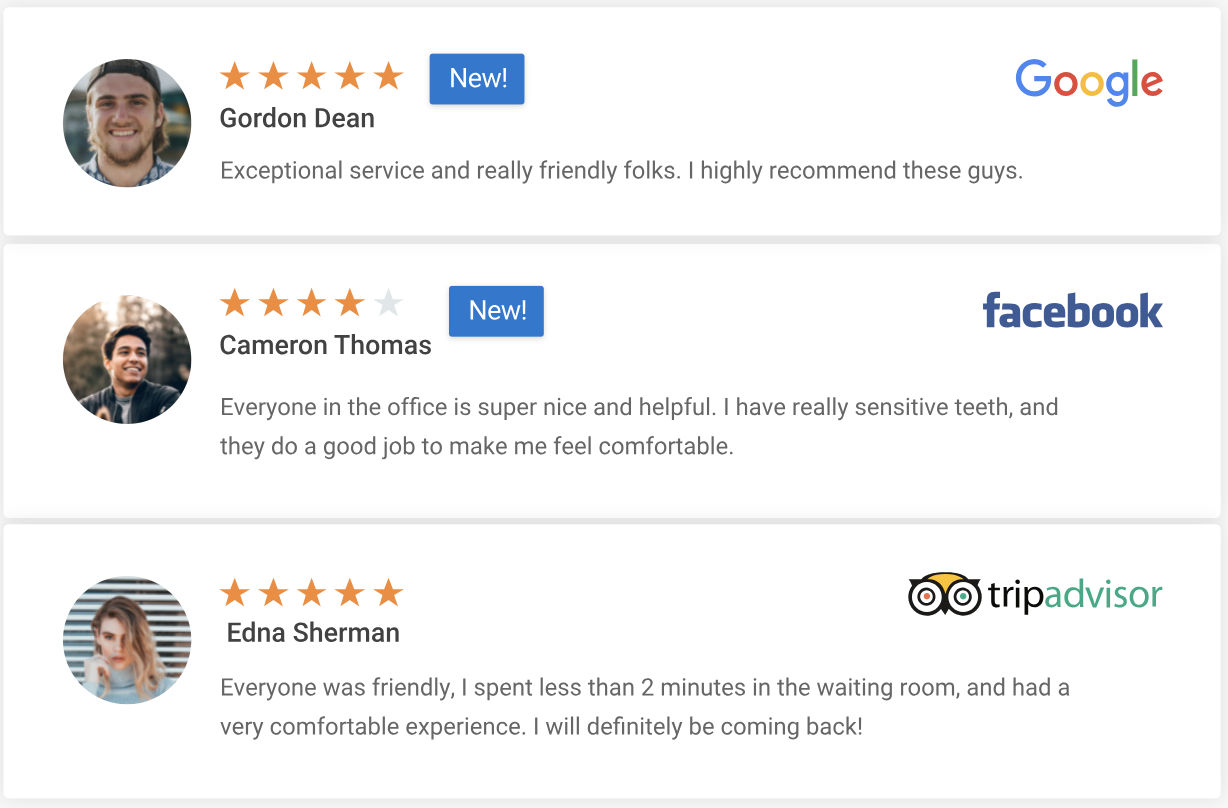
Image courtesy of BirdEye.
5. Cision
Cision Communications Cloud lets you track your brand mentions across millions of online stories, as well as any social media mentions. Best of all, Cision helps you reach audiences across traditional, digital, and social platforms, ensuring your brand is consistently successful across all marketing channels.
While Cision provides tools to ensure you're able to monitor and protect your online brand, its features are particularly impressive for strategic, proactive PR outreach. For instance, Cision helps you find media outlets and specific contacts within the industry to reach out with pitches, or figure out which industry influencers can best help spread your message and positively impact your brand's image.
Cision also provides automated analysis to help you translate your campaigns into valuable global insights. The tool is used by companies such as Comcast and Bayer.
Price: Custom depending on your size and business needs. (Ask for quote here).
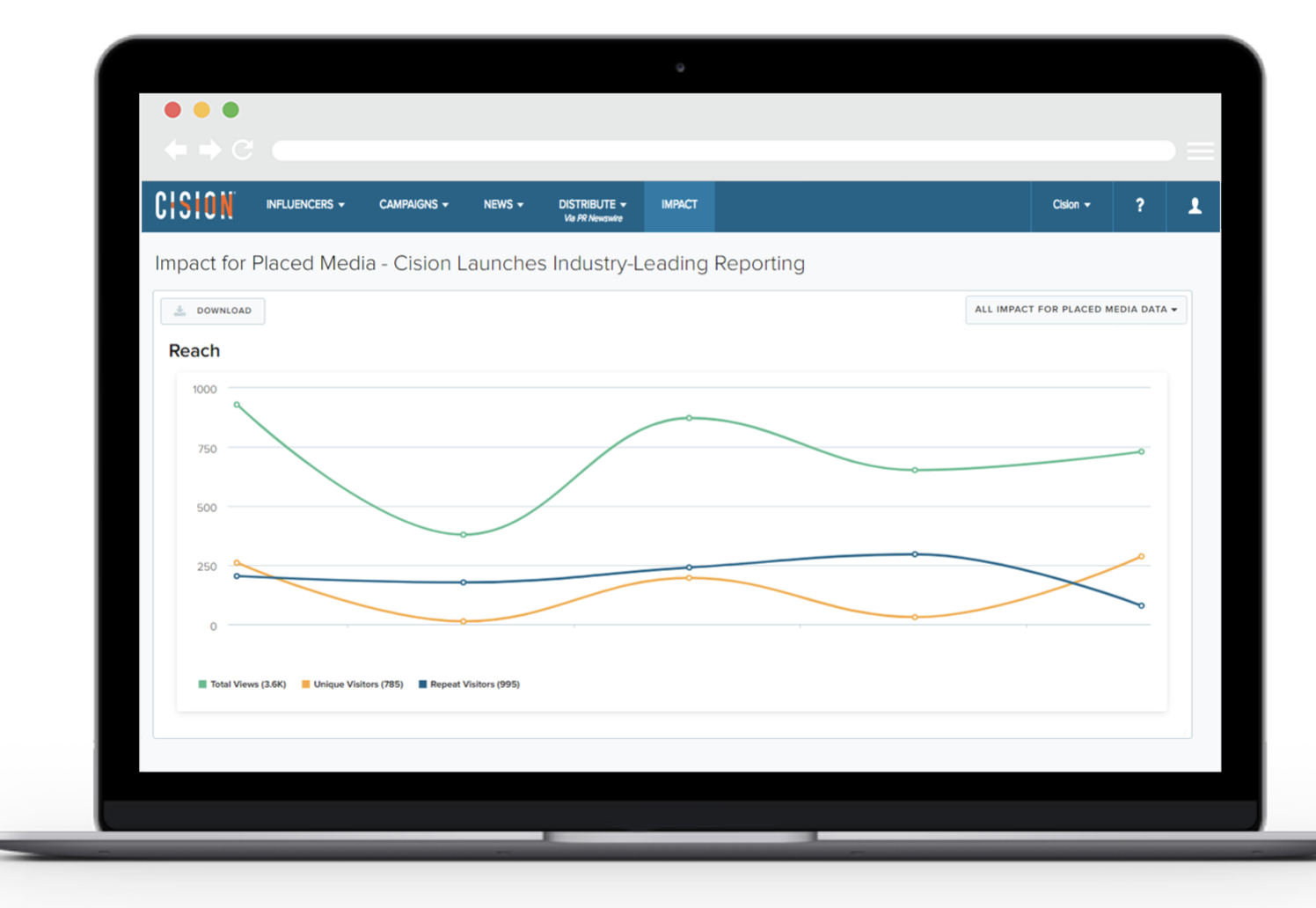
Image courtesy of Cision
Corporate Reputation Management
To understand how a business might implement a reputation management strategy, I spoke with Ellie Flanagan, Senior Corporate Communications Manager at HubSpot.
She told me -- "The first step in shoring up your brand's presence online is making sure that all of your owned channels reflect your current imagery, messaging, and values. Check for out-dated logos, company descriptions, or mission statements. It's also helpful to do regular audits of other places where your logo or brand might be in use -- such as on partner or customer websites."
To conduct regular audits, you might use one of the software tools listed above. Additionally, you can use a reputation management software to check for inconsistencies, such as Yext. Alternatively, there are tools such as Express Update or My Business Listing Manager that help you monitor for out-dated information (check out A Comprehensive Guide to Local SEO in 2019 to learn more).
Flanagan also suggested, "Make sure you have clear language on your own website that outlines your company's trademarks and sets guidelines for how others can use your brand assets. That will be a helpful reference in the event that you need to reach out to someone who's using your brand incorrectly or without permission."
I also spoke with Alice Sol, a Public Relations Specialist at HubSpot. She told me -- "Protecting your brand has never been more important, and that goes hand-in-hand with customer trust. We live in a world where information travels rapidly and we can get a response in seconds at the touch of a button. Technology has enabled us, as consumers, to get in-touch with brands quickly -- at the same time, it's given brands the ability to form deeper connections and resolve issues faster."Ultimately, it's critical you respond to negative feedback to ensure high customer satisfaction. Responding to negative reviews will help you maintain trust and loyalty among your customers. Additionally, it could actually help you grow your business -- 45 percent of consumers say that they're more likely to visit a business if it responds to negative reviews.
When responding to a negative review, it's important you provide actionable, helpful solutions whenever possible. Avoid getting defensive or making excuses -- at best, tell your customer you're sorry they were disappointed in the service you provided.
Sol also advises businesses to do their best to meet customer needs and ensure a seamless experience, start-to-finish. She says, "The stakes [on delivering a good experience] are getting higher. 80% of consumers say they have stopped doing business with a company because of a poor experience. If a customer has a bad experience, technology allows information about that experience to travel quickly. At the same time, if a customer has a very positive experience, that creates a strong brand reputation and forms trust."
"Your customers are your biggest asset and it's critical to take those needs very seriously by responding in a timely manner and communicating effectively."
To sum it up, when protecting your online reputation, you'll want to focus on the following tactics:
- Make sure all your owned channels reflect your current imagery, messaging, and values
- Ensure all online information regarding your business is up-to-date and consistent
- Use clear language on your own website to outline your company's trademarks and set guidelines
- Cultivate a positive user experience, start-to-finish
- Listen to customer feedback and respond to negative feedback with helpful, actionable solutions when possible
If you want further information regarding how to cultivate a comprehensive, cohesive customer experience, take a look at How to Define a Customer Experience (CX) Strategy, which provides you with the six areas of a successful digital customer strategy.


from Marketing http://bit.ly/2IUcvMk
YouTube to Stream 13 Major League Baseball Games Live Globally
The 13 games will be distributed on YouTube globally, and exclusively in the US, Canada, and Puerto Rico.
from RSS Feeds | INTERNET - RSS Feed - NDTV Gadgets360.com http://bit.ly/2IOPiLy
from RSS Feeds | INTERNET - RSS Feed - NDTV Gadgets360.com http://bit.ly/2IOPiLy
Flipkart Flipstart Days Sale Kicks Off: The Best Deals Available Right Now
Flipkart Flipstart Days sale offers deals on hundreds of products. We've handpicked some of the best offers you can grab right now.
from RSS Feeds | INTERNET - RSS Feed - NDTV Gadgets360.com http://bit.ly/2GW7BfK
from RSS Feeds | INTERNET - RSS Feed - NDTV Gadgets360.com http://bit.ly/2GW7BfK
Subscribe to:
Posts (Atom)
How Can I Stop My Wife From Badgering Our Friends About Climate Change?
By Philip Galanes from NYT Style https://ift.tt/WkUwcyA

-
By Unknown Author from NYT Style https://ift.tt/2IH8rQj
-
By Jacob Gallagher and Saeed Rahbaran from NYT Style https://ift.tt/yZeYwsM
-
By Rhonda Garelick from NYT Style https://ift.tt/RbW3pKV


